JOANNA'S FOOD: family cooking, from scratch, every day


Showing posts with label vegetables. Show all posts

Thursday, October 14, 2010

Creamy Puy lentils

Luxurious way with lentils. We ate this with chunks of squash roasted with herbs and orange zest. Horatio said it would have been nicer with chicken, but he's a well-known lentil hater.

200g Puy lentils
1 finely chopped onion
1 clove finely chopped garlic
juice of an orange
1 tbsp balsamic vinegar
2-3 tbsp creme fraiche

Cook the lentils (about 20-30 minutes, depending on their age). Drain, but keep the water, which will be thick and black.

At the same time, fry the onion until it is soft, then add the garlic and keep cooking for five more minutes. Add the orange juice, vinegar, creme fraiche and a little blackwater (start with 1-2 tbsp). Warm through, then add the lentils. Taste and season.

Saturday, March 27, 2010

Garlic paste


Here's a worthwhile time-saver: garlic paste on hand in the fridge, no need to fry off before adding to - well, anything you're cooking, really. You just need a food mill, unless you've got strong arms and a sieve. Keeps well.


8 heads of garlic
2-3 bay leaves
a bunch of thyme
peppercorns and salt
a little oil
water

Break the heads into cloves, but no need to peel them. Put in a single layer on a baking tray; add the peppercorns and herbs, a splash of oil and enough water to come not quite half way up. Cover the dish with foil. Bake for 90 minutes at 150C, until the garlic is completely soft.

Fish out the pepper and bay leaves, and some of the twiggier bits of thyme. Drain and push through a mill or sieve. Add a little sea salt and bottle. Keep in the fridge.

Note: These quantities make about 300ml.


Saturday, February 06, 2010

Raymond Blanc's tomato essence

Five years ago, when I started this blog, I posted two recipes on the first day. One of them has reappeared in the Telegraph, which is where I think I got it in the first place. It is Raymond Blanc's truly wonderful tomato essence ... glamour without much effort, haute cuisine without the high price of Le Manoir**. Although it's a little shocking that Monsieur Seasonality is suggesting tomatoes so early in the year.

The fundamental recipe hasn't changed - why tinker with perfection? And now, M Blanc suggests that, as well as using the golden liquid as a soup, you can use it in a tomato risotto. I'll be posting that one day soon.

Tuesday, December 22, 2009

Brussels sprouts with caramelised garlic and lemon


We're snowed in here, so it's been a day of quiet pleasures: a walk round the wood, a little photography, some bird watching, a game of croquet in the snow, and Horatio is building an igloo which he plans to sleep in (shades of his father, for those with long memories). I had time to make a complex three-stage recipe, which in the ordinary way I wouldn't have bothered with: the most delicious brussels sprouts with caramelised garlic and crystalised lemon peel. So good that they'll be made here again and again.

Actually, this is a recipe you can make ahead: two of the three stages could easily be made the day before. And if you don't like brussels sprouts, you could leave them out and just have the caramelised garlic.

The unusual combination of flavours is the brainchild of Yotam Ottolenghi, and his recipe appeared in the Guardian on Saturday.


Best-ever brussels sprouts

4 heads garlic, cloves separated and peeled
olive oil
balsamic vinegar
caster sugar
water
1 lemon
600g sprouts (I used around 400g)
1 chilli, finely chopped (or a little chilli jam)

Put the garlic cloves in a pan of water and blanch for three minutes. Drain. Fry the garlic in a couple of tablespoons of olive oil; put them on a high heat and keep turning them until they are golden. Then put in a few drops of balsamic vinegar, a tablespoon of sugar, 90ml water and a pinch of salt. Simmer until there's virtually no liquid left (about five minutes).

Make julienne strips from the lemon peel (you can either use a potato peeler plus knife, or, if you've got it, one of those hole-y implements that make fine strips of zest). Put them in a small pan with a tablespoon of sugar, and the lemon juice made up to 100ml with a little water. Cook until the syrup is reduced to almost nothing (about 15 minutes).

Trim and halve the sprouts. Fry them in olive oil (in batches) at a high heat for about five minutes. Don't stir them more than once or twice, otherwise they won't char.

Stir everything together in a bowl (Ottolenghi specifies a chopped chilli, but I didn't have such a thing, so stirred in a couple of teaspoons of chilli jam). You may need to add more oil. Eat hot, or at room temperature.

PS Ottolenghi strew his dish with shaved parmesan and basil leaves, but I didn't; we don't have out-of-season basil leaves at this time of year, and the parmesan seemed to me to be over-egging the pudding. Unbelievably good without.

Friday, December 04, 2009

Tasty fat-free mushrooms

Mushrooms, like aubergines, soak up oil if you give them the chance. Here's a way of locking in taste without using any fat at all.

Put equal quantities of wine* and stock** in the pan - just enough to stop your mushroom slices burning. Add a few drops of Worcester sauce, or soy sauce, or balsamic vinegar. Put the pan on a medium heat. Watch and stir. The mushrooms will exude their juices after a few minutes; turn up the heat and boil off all the liquid. Watch them carefully; they are ready when the last of the liquid evaporates. Delicious.


* red or white is fine; I sometimes use Marsala, which gives a strong flavour to the mushrooms (not great at breakfast)

** I've always got stock in the fridge, either chicken stock, or Fergus Henderson's fabulous trotter gear. If you don't go in for this sort of thing, just use bouillon


Related links

Foolproof recipe for fuss-free chicken stock
Jellied pork stock - easy to make, keeps for months in the fridge, adds depth to everything it touches

Tuesday, November 24, 2009

Alice Waters' Brussels sprouts

I love this new take on Brussels sprouts ... Alice Waters' new recipe in time for Thanksgiving. We don't just save sprouts for Xmas eating, so I'll be giving it a try in the next few days.

Wednesday, November 11, 2009

Trina's beetroot burgers

I'm not sure why I chose the beetroot burgers. It wasn't as if there were beetroots rotting at the bottom of my veg box; I had to go out specially to buy them.

And then I didn't have the courage of my convictions: I felt embarrassed at serving beetroot burgers, and it's taken me so long to write about it that I've forgotten what else was on the plate.

But they were delicious. Really delicious. Both of us ate more. Something to add to the collection of good things to eat on a vegetarian night.

The recipe comes from The Nordic Diet by Trina Hahnemann, a riposte to the prevailing notion that only Italian/Mediterranean food is healthy - loads of seasonal dishes for northern Europeans to eat well through the winter without air-freighting summer foods from the southern hemisphere. (Also interesting summer dishes, but that's for another season.)

So, slow-growing grains - oats, rye, barley, spelt - mingle with cold water fish such as mackerel, herring, haddock; and an entirely new take on the kinds of vegetables schools once made a point of overcooking and then forcing down the throats of reluctant pupils. (At my primary school, we weren't allowed to leave the table until we'd eaten everything: I never went to lessons on Friday afternoon, because I couldn't manage the slice of Edam; my friend DD was done down by beetroot on Wednesdays; and Elsie McA never went to school at all in the afternoons.) Also modern ideas for cooking game which I'll be exploring.

Beetroot burgers
for 2

300g grated raw beetroot
50g oatmeal
2 small eggs (or 1 large egg)
1 shallott, finely chopped
1 tbsp chopped dill
1 tbsp chopped parsley
a little oil for frying

Mix the ingredients in a large bowl and set aside for an hour.

Heat the oven to 180C.

Squeeze together flat cakes of the mixture (or make one big cake, that's certainly what I'll do next time). Fry on both sides until golden, then transfer to an ovenproof dish and bake for 20 minutes.

Trina serves this with a barley salad (cooked grains mixed with chopped celery and parsley dressed with vinaigrette). I think we had boiled potato and a green salad.

The Nordic Diet by Trina Hahnemann is due out in January, £12.99. Published by Quadrille Books, to whom thanks for the advance copy.

Related posts

Beetroot
Beetroot salad

Thursday, October 22, 2009

Deborah Madison's sorrel and lentil soup


This is the early-morning view from my kitchen window .. not surprising that we're no longer eating much salad, and that I'm thinking of braising vegetables and making soups.

I'd never heard of the American food writer Deborah Madison until my sister (who is now an American) gave me Local Flavours, a celebration of farmers' markets. Even then, I didn't twig that it's a vegetarian book (I'm still not sure whether DM herself is a veggie). Whatever, she's got serious style.

Two links, the first to Deborah Madison's potluck dinner - the best tableware, Julia Child boeuf bourgignon, fabulous bread, pears poached in wine and gilded with gold leaf, a grape galette, good wine ... and then, as if all that wasn't enough, with half an hour to go, DM thought she'd make an amuse-bouche of sorrel and lentil soup, which is the second link (although the quick I'm-doing-this-at-the-last-minute method is probably the one to go for, assuming you have a pressure cooker, which I no longer do).

Local Flavours is a good read, although I've never followed any of the recipes, because it's all in imperial measurements and cups, which is tricky for a European metric cook. I am, however, seriously tempted by the braised root veg with black lentils and red wine sauce ... it's one of those dishes that takes most of the day, although not much input from the cook. And now that I look at the detail, there's not a cup in sight. No excuses, then.


If you're not sure what sorrel is, here's a link to a post I wrote a couple of years ago about growing and cooking with sorrel

Wednesday, September 30, 2009

Buttered and creamed parsnips

Parsnips are just beginning to appear in the shops (although they'll be sweeter once there's been a frost). Lettice made dinner last night, a very good slow roast of pork (1.8 kg took three hours at 140C). She chose to make her favourite winter vegetable dish, creamed parsnips, and she'd be the first to admit they weren't a great triumph.

It's often best to go back to the beginning when you've had a culinary disaster. So I'm giving the recipes here; they're from Jane Grigson's Vegetable Book, and they appear consecutively. She also gives a John Evelyn recipe for buttered parsnips dating back to 1699, which you serve with a bowl of sugar and cinnamon and a bowl of melted butter. Maybe we'll skip that one.

Buttered parsnips


Scrub, boil and cool the parsnips under the cold tap. Peel off the skin and slice or quarter them as appropriate to their size. Cut away any hard core. Melt a good generous knob of butter in a frying pan and turn the pieces over and over in it, adding plenty of pepper. They should not brown or fry in any proper sense of the word. They just need to absorb butteriness. Add a little extra butter and plenty of chopped parsley, or a mixture of parsley, chives and tarragon, and serve with meat, with cod, or on their own.

Creamed parsnips


Follow the recipe for buttered parsnips, but pour on some whipping or double cream before you add the herbs. Not a great deal, just enough to make a coating sauce, with the pan juices.

I use spices rather than herbs - mainly nutmeg. Next time I'll try using herbs.

And remember: they just need to absorb the butteriness. It's amazing what a treat you can make out of the humble parsnip with a little care.

Tuesday, September 15, 2009

Nigel Slater's stuffed courgettes with dill sauce and mince


We had a delicious dinner last night, courtesy of ideas from Nigel Slater's new book - although I probably could have made something similar after reading one of his old ones.

I have a bit of a love/hate relationship with Slater - it irritates me that he treats himself as one of the immortals in the Observer Food Monthly magazine that he edits. On the other hand, his journalism keeps him in the moment, and he's very good at reinventing the same ideas for a new day. So cook-your-own-veg was always going to be the topic for the next book (actually the next two, this announces itself as volume one).

Since his plot is a tiny London garden, and since he buys most of the veg he eats, he's aware that he's a candidate for Pseud's Corner, which results in some nicely self-mocking moments. But there's a little too much smugness, and this made me laugh out loud:

Watching someone you love eat a tomato you have grown yourself makes it more than just a tomato. It becomes a source of glorious, yet strangely humbling, pleasure.
I mean, per-lease ... who does he think he is?

Overall, A cook and his vegetable patch is good. After you've read the introductory pages, it's a book for browsing and consulting rather than reading straight through; it's arranged alphabetically by vegetable and/or groups of vegetable - lots of plants you'd like to eat and grow.

It's not quite sure whether to be a gardening book or a cookery book (and not quite so successful at blending the two as Christopher Lloyd's Gardener Cook). So there aren't always horticultural notes, but there are lists and lists of Slater's favourite varieties.

Here, for instance, is his list of chard (since there's still just time to sow one last row, something I should be doing right now):
Swiss Chard Classic variety with green leaves and very wide, flat stems. Sometimes known as silver beet.

Wavy Leaf What it says on the packet.

Rhubarb Chard Green-maroon leaves, vermillion veins and stems. Slightly less hardy than the others.

Bright Lights Green leaves with veins and stems of raspberry pink, blood red, saffron, orange and yellow. Similar to Jacob's Coat and Rainbow mixtures.

Oriole Deep gold viens, very dark leaves.

Fordhook Giant Large, flat white stems, curling green leaves. This is one to cook leaves and stalks separately.

Last night, I wanted to tackle the courgette and summer squash mountain that has been quietly stacking up here. So the new book was an obvious place to look for inspiration (it's definitely that moment of the summer when I'm literally fed up with my "usual" courgette recipes). Since the courgettes were to be the main part of the meal, I chose to make Slater's fruit and nut filling to sprinkle onto a dish of sliced squash, accompanied by a little mince fried to crispy nubbly delicious lumps (typical Slater, something he's written about before). And there was an interesting cold dill sauce to go with it.

I followed the instructions pretty accurately for the stuffing/topping. Next time, I wouldn't bother with the couscous, I'd just use breadcrumbs for a softer result.
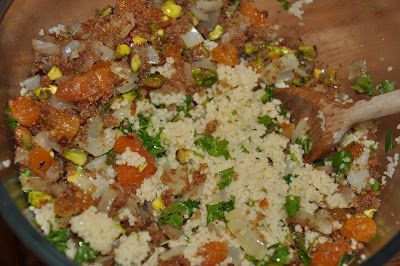


Fruit and nut filling for baked courgettes
for 4

1 onion, chopped
olive oil
50g fresh white breadcrumbs
50g dried apricots, finely chopped
40g pistachios, chopped
150g couscous
250ml hot stock
tbsp thyme leaves, chopped
grated zest of a lemon
tbsp chopped parsley
8 medium courgettes

Oven 180C

Pour the stock onto the couscous, add a glug of olive oil, cover with a plate for 10 minutes. Soften the onion in some oil; add the breadcrumbs, apricot and pistachios. Take off the heat. When the couscous has taken up all the liquid, mix in the breadcrumbs, herbs and zest.

Halve the courgettes lengthwise and put in a single layer in an ovenproof dish. Sprinkle on the stuffing, then cover with foil or greaseproof paper.

They'll take about half an hour, more if you've put in some slices of summer squash.

Dill sauce

Finely chop a small bunch of dill. Bash a clove of garlic and combine with 2 tablespoons of wine vinegar, 3 of olive oil, and 4 of yoghurt.

If you want to turn this into a sort of deconstructed traditional stuffed marrow, then cook some mince: Heat a little oil in a frying pan; when it is smoking hot, drop in pieces of mince and LEAVE THEM until they have crisped at the edges. Add dill, chopped garlic, lemon zest, chilli jam (or chopped fresh chilli). Turn the meat. When it's cooked through, add salt and chopped parsley before serving. Slater's recipe uses minced pork; I used minced beef because that was what I had.


PS I take some of this back: I've just spotted that NS no longer edits the Observer Food Monthly. But someone, maybe the telly critic, did describe him as God in last weekend's paper. Harrumph

Monday, August 10, 2009

Imam biyaldi -ish


My sister and two of her sons are visiting from California, so we're at least eight for every meal - more often, though, into double figures, and fetching chairs from all over the house, even when we're eating in the garden.

The tomatoes in the greenhouse are a tangle of good intentions thwarted, but even so, there is lots of fruit to pick if you can find it in the jungle of untied plants. And so our salads have been beautiful.


With so many in the house, food needs to be simple to produce - but with so many young men, it also needs to be plentiful. Last night, we ate roast chicken, roast potatoes, courgettes, and a simple imam biyaldi, which I made by splitting aubergines lengthwise, baking them in a hot oven for 20 minutes before smearing them with a tomato sauce made by cooking down the remains of a tomato salad. They went back into the oven for another 10 minutes or so.

For pudding, we ate Tartuffo - my pa, who is in his late 80s and no longer eats much, had thirds, fourths, possibly even fifths. It's Willie Harcourt-Cooze's recipe, and I made it with his Peruvian Black chocolate and lovely yellow Guernsey cream from the Berkeley Farm dairy on the Marlborough Downs. The pudding was stirred while my sister and I caught up with a year's worth of family minutiae ... it doesn't get much better. Except that tonight, my sons are going to cook the roast potatoes, always a good moment, and my father has ordered one in the shape of the Eiffel Tower.

Related links

A couple of summers ago, the boys were adamant that my "girlie" roast potatoes didn't quite cut the mustard, and so we ate them three nights in a row, while everyone put their oar in ...

The roast potato taste test

That's enough roast potatoes

and then, a little later, disaster struck the water supply, and I was reduced to buying Frozen roast potatoes


Things to do with tomatoes

Roasting tomatoes
Roasted tomato ketchup
Slow roasted tomatoes
Homemade tomato ketchup - and caponata-ish
Panzanilla
Chilli jam
Preserving tomatoes in brine

Tasty tomatoes to grow
Dry-bottled tomatoes

Links to tomatoes on other blogs

Fried green tomatoes - haven't you always wanted to know how to make these? Here's how, from the blog at the Whistlestop Cafe
David Lebovitz's take on an heirloom tomato salad
Gazpacho from Kalyn's Kitchen

Wednesday, June 17, 2009

Vichy carrots - and with a balsamic twist


Vichy carrots are a great way to use up old carrots. Simply slice them fairly small, put them in a pan with a knob of butter, a sprinkling of sugar or honey, and a little water. Cook on a high heat, shaking occasionally, and add more water if necessary. You need to be cautious with the water, because it should all have evaporated when the carrots are ready, covering them with a syrupy coating. When they're done, add some chopped parsley (I didn't have any).

And if you like, add a little balsamic vinegar before serving. That's what I meant to do for Lettice's lunch today, as she loves balsamic ... but I forgot. Hey ho.

Monday, April 27, 2009

Cucumber and dill pickle


Last autumn, I bought The Wonderful Weekend Book by Elspeth Thompson - I am not damning it with feint praise when I say that it is charming, also much the best of the recent deluge of books on home-making for the nostalgic.

Elspeth gives a really wonderful recipe for cucumber and dill pickle, and I made a huge vat with the last of the cucumbers. I've been eking it out carefully, as it is so delicious. But now the first cucumbers have arrived in my vegetable box, so I can polish off the few remaining slices and make some more.

I didn't post this when I made it, because there were no more cucumbers (I don't really think it would be a good idea to make this with watery winter indoor fruits). It can also be made with courgette, although I haven't yet tried that.


Courgette and dill pickle
for four 450g jars

It always seems to me a miracle that something submerged in liquid can retain its crunch, but this does. And the flavours are great from day one, none of that leaving it to mature until Christmas that you have to do with chutney. I've found this is terrific with my usual lunch of leftovers, almost as good as chilli jam.

3 large cucumbers (or 6 courgettes)
2 large onions
50g coarse salt
450g soft brown sugar
600ml cider vinegar
1 tbsp whole mustard seeds
a large handful of fresh dill

Thinly slice the cucumbers and onions, and this is easiest on a mandoline. Layer with salt in a large plastic box, and weight down with a plate and some tins. Leave it four at least four hours, then drain and rinse in a big colander. You want to get all the salt out.

Dissolve the sugar in the vinegar, then add the veg, seeds and dill. Bring to the boil. After one minute, drain, reserving the liquid. Boil to a syrup (which will mean boiling off around one third). Meanwhile, put the vegetables in sterilised jars. Cover with juices, and seal. Keep in the fridge once you've re-opened the jar.


Other good preserves

Spiced apricot preserve
this one is BRILLIANT for an instant gravy to go with roast pork
Roasted tomato ketchup very good for cooking
Home-made vanilla extract easy, and satisfies my need for the semblance of thrift
Rose petal jelly it will soon be time to make this, the buds are swelling - and it's pouring with rain at the moment, which can only be good for the roses


PS Elspeth has a new book about to come out ... she says on her blog today that it's already in some shops, so I'm hoping the postman will deliver my copy today

Tuesday, February 03, 2009

Beetroot gratin

This idea for cooking beetroot came with the Riverford veg box last week. Delicious.

Preheat the oven to 160C

Slice raw beetroot into a bowl. Add a little chopped garlic and rosemary (or thyme, or summer savoury when the moment comes). Salt if you like. Pour on a little cream - not too much, or it will bubble up and boil over, making a lurid mess in your oven (or on the potatoes baking beneath, in my case). Mix well so that all the beetroot is coated.

Arrange in a gratin dish, cover with foil and bake for 45-60 minutes. You can uncover it for the last 10 minutes if you remember.

Thursday, December 11, 2008

Jellied stock good enough to eat on its own


Okay, this post is not for the squeamish. But it IS for anyone who likes complex flavours in their food, for anyone who hates waste, and for anyone who has access to a butcher's shop. Emphatically not supermarket food.

For once, I'm following a recipe to the letter. Next time I won't be so literal ... I won't put in as much Madeira, because the result is very sweet. It's not exactly a waste of good Madeira, because the taste shines through, but in this house I think we'd probably rather drink it than use it quite so liberally in the cooking.

The recipe comes from Fergus Henderson's book Beyond Nose to Tail Eating. It's the sequel to Nose to Tail Eating, a book which I have not yet read, although I ordered both at the same time. The recipe for this wondrous stock - which Henderson calls Trotter Gear - has been several years in the making, and therefore does not appear in the first book. But loads of the dishes Henderson makes with it are in both books, and I will definitely be making them.


Trotter gear

6 pig's trotters (I used four)
2 onions (peeled)
2 carrots
2 sticks of celery
2 leeks
1 head of garlic
thyme
a handful of peppercorns
1/2 bottle of Madeira
enough chicken stock to cover the trotters

Get the butcher to split the trotters. Put them in a large casserole, cover with water and boil for five minutes. Drain and rinse off the scum. Put back into the rinsed casserole with all the other ingredients. Bring to a simmer, then put in a low oven for three hours or more - until the meat is falling off the bone.

When the trotters are cool enough to handle, strip off the flesh. Shred it, and put into a Le Parfait jar. Strain the stock over it. Seal, and keep in the fridge. Do this while everything is still warm, because it's much harder when the meat is cold.


If you are a little squeamish but have managed so far, you could just strain the stock off, and not worry about using the meat. I might do this next time, because my dogs were keen as mustard to get hold of the trotters, and they'd be a fabulous treat for two Jack Russells.

Either way, the meaty basis of this nectar cost £1. Jellied stock, sitting in my fridge. Five minutes' work. So many possibilities.


Saturday, December 06, 2008

Red cabbage salad for winter days


The other day, Lettice was moaning about the lack of salad at this time of year: I HATE winter ... she's missing soft salad already, but we really are committed to not buying leaves which are flown in from abroad. This red cabbage salad was my response, we've eaten loads of variations.

Finely chop as much red cabbage as you need. Grate some orange zest onto it. Squeeze the juice from the orange, add a little salt, some oil. Chop parsley, perhaps some leeks too; grate carrot. Mix everything together. You could add caraway if you've got some.

I've made it with clementines (as you see): great, but they're hard to zest - and the zest really does add zing, so I'd be loathe to leave it out.

Friday, December 05, 2008

A winter celery salad


I've posted at least a couple of Waldorf-ish salads over the years, and here's another one. I love celery.

Apples, chopped; celery; a few sunflower seeds; a splash of red wine vinegar; a slightly bigger splash of olive oil; coarsely ground black pepper. Mix in the serving bowl.

Two ingredients worth mentioning here: the apples were russets, something you never used to see in a supermarket, and with much thinner skins than when I was a child. And - star of the show - Fenland winter celery, bang in the middle of its short season in England right now ... really delicious & worth the premium: it's lovely and pale, it's not stringy, it's got a nutty taste, and I'm confident that it will convert my celery-hating husband. (You have to wash it carefully, as the whiteness is achieved the traditional way, by banking up the plants with earth, to stop the light getting in.)

Related posts

Sort of Waldorf salad
A lighter Waldorf salad
Caponatina - a sweet/sour salad with celery and other vegetables

Wednesday, December 03, 2008

Heart of the Matter round up: whole grains


Grains were the subject of this month's Heart of the Matter ... and here you'll find a small number of very good ideas from some of the best bloggers around. Cooking wholegrains always seems tricky to me: there's that whiff of 70s sandal-wearing earnest hippie-dom which is hard to shake off - boring brown food that tastes like horsefeed.

Not these days. The 21st century way with wholegrains is altogether tastier, somehow less earnest. I've been experimenting with the help of a highly recommended book, A Cook's Guide to Grains by Jenni Muir. Now I'm planning to add these dishes to my staple repertoire - these are all easily achievable, mostly quite quick, all of them the kind of recipes you can fiddle with to add your own stamp.


Labelga's quinoa flakes with spinach and red chilli is ready in 10 minutes, so there are no excuses for not giving this a go. It's one of Labelga's AAP dishes - another alternative to pizza! As you can see from the picture, the flakes are spread onto the plate, then topped with this fabulous spiced mixture. Find it at Leafy Cooking.


Christine at Kits Chow made vegetarian multigrain rice with vegetables, inspired by a Japanese rice dish, matsutake gohan (rice with mushrooms). This is something to get you experimenting - there are five grains: brown rice, black glutinous rice, buckwheat groats, oat groats and millet.


Bee and Jai have been doing some hard thinking about what they buy, cook and eat. Their post for Heart of the Matter is interesting and inspirational - they share their personal "rules", and finish with a versatile recipe for roti: this one is sourdough Swiss chard and cornmeal. You'll find it at Jugalbandi, always a good read.


I often think of cooking wholegrains as time-consuming, but here's another recipe that shows that wholegrains can be quick and easy. Michelle The Accidental Scientist, one of my co-hosts for HotM, makes this Mexican style rice when she's short of time, as an accompaniment to fish, tacos, beans - lots of links to these and other recipes.


Co-host Ilva at Lucullian Delights has stuffed courgettes with kamut grains which she found when out shopping a little while ago. As always with Ilva's food, it's beautiful and packed with flavours: she calls her dish oven baked zucchini filled with kamut, olives, thyme and parsley.

Olive Oyl is a blogger without a blog, and she's sent me this variation on the traditional Greek dish spanakorizo (Spinach rice), another happy & easy meal:

Plenty for 2 hungry people, also good cold the next day

Chop an onion and gently fry in a biggish saucepan, in a good glug of olive oil. Rough chop around four heads of spinach, I often also add sorrel, baby nettles and cleavers, depending on what's growing, and add to the pan, cover and let sweat for five minutes. Next add 250gms of brown rice, 600ml of water and juice of a lemon. Bring to the boil, season,cover and turn the heat down. Check after about 20 minutes, stir, add water as needed and so on until cooked (usually around 50 minutes)you might also want to add at this point a good few fistfuls of herbs such as mint, parsley, celery leaves, dill. When cooked it has the consistency of risotto and is a beautiful emerald green. Be more or less heart healthy with a grating of cheese on top.


Nearly forgot: I blogged two grain dishes at Joanna's Food - Skirlie, a cheap and cheerful Scots dish made with oats, and these great six-seeded rolls.

Thanks to everyone for taking part, and watch out for the announcement for December's Heart of the Matter

Tuesday, November 25, 2008

10 ways with mashed potatoes

On a grey rainy day last week, I test drove a new-to-me car. I picked it up on another rainy day. The next morning, there was an inch of snow on it. None of this would matter, except that it's a convertible. Mad. I still haven't driven it with the roof down. And now we're into winter comfort food: lunch at the weekend was game stew and mash, just what was needed now the weather's closing in till spring.

Hugh Fearnley-Whittingstall found 11 things to add to mash this weekend ... on top of the 100g of butter and 200ml of hot milk he adds per kilo of potatoes (or 100ml each of cream and milk).

Here, mashing is both favourite and least favourite way to cook potatoes. Some people like them better than any; others say it's a waste of a good potato. Sometimes I find myself making two types of potatoes. Who says I'm not an indulgent wife and mother?

Here are 5 ways I make mash:

  1. When I'm mashing potatoes, I routinely add milk, nearly always skimmed
  2. Sometimes, I add a good dollop of grainy mustard; good with ham
  3. A spoonful of grated horseradish (from a jar, as I don't grow it) is delicious with roast beef
  4. Olive oil added to mash instead of milk is particularly good with fish, or if you're going to use the potato as a pie topping
  5. Or you can use a little cheese (and something from the onion family finely chopped) to perk up a pie of leftovers
HFW does all that and more:
  1. Add some unpeeled cloves of garlic to the pot with the potatoes, then squeeze the puree out and beat into the mash
  2. Add a few slices of caramelized shallot and some Bramley puree for a mash to go with roast pork
  3. Infuse the milk with a bay leaf and grated lemon zest (to accompany fish)
  4. Add Jerusalem artichokes and nutmeg (roast lamb)
  5. Grated cheese and roasted chopped poblano chillies, to go with steak. Steak??? Is he mad? If steak, then chips, no question.
What do YOU do with mash? I'd love to know, it's my favourite

Monday, November 10, 2008

Pumpkins to grow and eat


These are the results of Sarah Raven's pumpkin trial, conducted this summer in the terrible conditions we had for squash. It was published in the Telegraph a few Saturdays ago - irritating, because who buys their seed now? But if I don't blog the results, the paper will float about the house for months, and I won't be able to find it when I need it. This post is all about striking a blow for tidiness.

I've grown some of these pumpkins, and completely agree with Sarah's findings, which is why I'm keen to keep hold of all this information for the moment when it's actually needed. And because not all of you may have a husband who is addicted to the Telegraph. The looks/longevity is for the florist in you; taste for your inner cook.

Crown of Thorns
Ornamental; stringy
Looks/longevity: 7/10
Taste: 2/10

Crown Prince
The blue one. Good taste; excellent storer. Seeds "horrid"
Looks/longevity: 10/10
Taste: 9/10

Giant Pink Banana
Huge. Good for soup. Flavour ok (not outstanding). Seeds "like cardboard"
Looks/longevity: 6/10
Taste: 7/10

Lumpy
Good producer. Watery/bland. Only good for lanterns
Looks/longevity: 6/10
Taste: 0/10

Zucca de Marmellata
Size varies wildly. Used in Italy for jams and chutneys. Seeds ok. Favourite of whole trial
Looks/longevity: 8/10
Taste: 9/10

Munchkin
Chestnutty flavour. Lovely tiny seeds. Ideal climbing plant over willow teepees
Looks/longevity: 10/10
Taste: 8/10

Potiron Tristar Triamble
Heavily rippled blue-green skin. Biggest producer. Not much flavour. Seeds good but tough
Looks/longevity: 10/10
Taste: 8/10

Queensland Blue
Similar to Crown Prince. Good producer, excellent storer. Seeds ok
Looks/longevity: 10/10
Taste: 9/10

Red Kuri
aka Uchikiri, aka red onion squash. Lovely sweet taste; skin soft enough to eat. In the top three
Looks/longevity: 9/10
Taste: 10/10

Rouge Vif d'Etampes
Huge, beautiful, poor producer. Sweet taste. Seeds okay
Looks/longevity: 10/10
Eating: 9/10

Snowman
Creamy green skin, creamy coloured flesh which is bright green at the seeds. Light cropping. Delicious, nutty flavour. Large tasty seeds. Will grow again
Looks/longevity: 8/10
Taste: 8/10

Sweet Dumpling
V dense dry flesh. Parsnip-like flavour. Good producer. Tiny tasty seeds. Good in small garden, can be trained up fence/trellis
Looks/longevity: 8/10
Taste: 7/10

Turk's Turban
Beautiful, ornamental only as stringy/watery/bland. Large tough tasty seeds. Only grow for ornament
Looks/longevity: 9/10
Taste: 2/10


As I typed out these findings, I realised that the marks are not entirely consistent with the remarks - but this information is a good starting point for seed-buying decisions in the spring. I've grown three of these, and regularly eat two more, and agree with every word. Now I'm looking forward to growing Queensland Blue and Zucca de Marmellata. Any comments from any of you who have grown some of these? Or further recommendations?


Related posts

Pumpkin in chilli oil
Butternut squash with parsley and mint softly spiced with cinnamon, a really good addition to a vegetarian dinner
Stuffed butternut squash - this is one of my most-visited posts, and a good cheap supper dish
Roast squash bites with pumpkin seed pesto - fabulous finger food, full of goodness
Pumpkin risotto